How Many Committees Are There in the House of Representatives

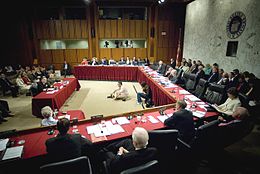
A congressional commission is a legislative sub-organization in the United States Congress that handles a specific duty (rather than the general duties of Congress). Committee membership enables members to develop specialized cognition of the matters under their jurisdiction. As "little legislatures", the committees monitor ongoing governmental operations, identify issues suitable for legislative review, get together and evaluate information, and recommend courses of action to their parent trunk. Woodrow Wilson one time wrote, "it is not far from the truth to say that Congress in session is Congress on public exhibition, whilst Congress in its committee rooms is Congress at work."[i] It is not expected that a member of Congress be an expert on all matters and subject areas that come before Congress.[2] Congressional committees provide valuable informational services to Congress past investigating and reporting about specialized subjects.
Congress divides its legislative, oversight, and internal administrative tasks among approximately 200 committees and subcommittees. Within assigned areas, these functional subunits gather data; compare and evaluate legislative alternatives; identify policy bug and propose solutions; select, determine, and report measures for total chamber consideration; monitor executive co-operative performance (oversight); and investigate allegations of wrongdoing.[3] The investigatory functions have always been a key office. In the tabling and diction of new constabulary, procedures such every bit the House discharge petition process (the process of bringing a bill onto the floor without a commission report or mandatory consent from its leadership) are so laborious and technical that committees, today, boss the draftsmanship and honing of the detail of many bills laid before Congress. Of the 73 discharge petitions submitted to the full House from 1995 through 2007, but one was successful in securing a definitive yea-or-nay vote for a bill.[iv]
The growth in autonomy and overlap of committees has fragmented ability of the Senate and of the Firm. This dispersion of power may, at times, weaken the legislative co-operative relative to the other two branches of the federal authorities, the executive and the judiciary. In his often cited article History of the House of Representatives, written in 1961, American scholar George B. Galloway (1898–1967) wrote: "In practice, Congress functions not as a unified institution, simply as a drove of semi-autonomous committees that seldom human action in unison." Galloway went on to cite committee autonomy as a factor interfering with the adoption of a coherent legislative program.[5] Such autonomy remains a characteristic characteristic of the committee system in Congress today.
History [edit]
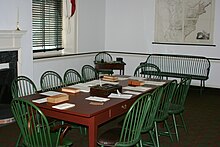
The second commission room upstairs in Congress Hall, Philadelphia, Pennsylvania.
In 1932, a reform move temporarily reduced the number of signatures required on belch petitions in the U.S. Business firm of Representatives from a ramble majority of 218 down to 145, i.east., from half to one-third of the House membership. This reform was abolished in a 1935 counterattack led by the intra-Business firm oligarchy.[6] Thus the era of the Slap-up Depression marks the last all-embracing change, albeit a curt-lived one, in the autonomy of House continuing committees.[7]
The modern committee construction stems from the Legislative Reorganization Deed of 1946, the first and near aggressive restructuring of the standing committee organization since the committee system was offset developed. The 1946 deed reduced the number of Business firm committees from 48 to 19 and the number of Senate committees from 33 to fifteen. Jurisdictions of all committees were codification by rule in their respective chambers, which helped consolidate or eliminate many existing committees and minimize jurisdictional conflicts.
The Joint Committee on the System of Congress, a temporary committee established in 1993 to conduct a policy and historical analysis of the committee system, adamant that while the 1946 Act was instrumental in streamlining the committee system, it did fail to limit the number of subcommittees allowed on any one committee. Today, Rules in the U.S. House of Representatives by and large limit each full commission to five subcommittees, with the exception of Appropriations (12 subcommittees), Armed Services (seven), Foreign Affairs (vii), and Transportation and Infrastructure (6).[8] There are no limits on the number of subcommittees in the U.Southward. Senate.
Congress has convened several other temporary review committees to analyze and make recommendations on ways to reform and improve the committee system. For instance, the Legislative Reorganization Act of 1970 led to further reforms to open Congress to further public visibility, strengthen its decision-making capacities, and augment minority rights. The 1970 Deed provided for recorded teller votes in the House's Committee of the Whole; immune minority political party committee members to telephone call their own witnesses during a twenty-four hours of hearings; established the Senate Committee on Veterans' Diplomacy; and enhanced the research capabilities of 2 legislative support agencies: the Congressional Research Service and the General Accounting Office.
Between 1994 to 2014, overall committee staffing was reduced by 35 pct.[9] The number of hearings held in the House declined from 6,000 hearings per year in the 1970s, to well-nigh four,000 hearings in 1994, and to simply over 2,000 hearings in 2014.[9] Commentators from both major parties have expressed concern regarding the loss of committee chapters to enquiry and develop legislative initiatives.[9] [ten]
Senate committees [edit]

The outset Senate commission was established April 7, 1789, to depict up Senate rules of process. In those early days, the Senate operated with temporary select committees, which were responsive to the unabridged Senate, with the total Senate selecting their jurisdiction and membership. This organization provided a great bargain of flexibility, as if one committee proved unresponsive, another could be established in its place. The Senate could also forgo commission referral for deportment on legislation or presidential nominations. These early committees generally consisted of three members for routine business and v members for more important bug. The largest commission established during the 1st Congress had eleven members, and was created to determine salaries of the president and vice president. As well in the first session, the entire membership of the Senate was divided into ii large committees, with half the senators on the committee to prepare legislation establishing the federal judiciary and the other half on the committee to ascertain the penalization of crimes against the United States.
This organisation proved ineffective, and then in 1816 the Senate adopted a formal system of 11 continuing committees with five members each. Three of those committees, the Finance, Foreign Relations and the Judiciary Committees be largely unchanged today, while the duties of the others have evolved into successor committees. With the advent of this new system, committees are able to handle long-term studies and investigations, in addition to regular legislative duties. According to the Senate Historical Role, "the significance of the alter from temporary to permanent committees was perhaps little realized at the time." With the growing responsibilities of the Senate, the committees gradually grew to be the key policy-making bodies of the Senate, instead of merely technical aids to the chamber.
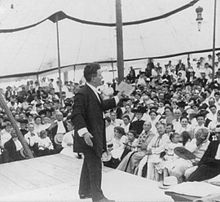
Governor La Follette of Wisconsin addressing the Chautauqua associates in Decatur, Illinois in 1905.
By 1906, the Senate maintained 66 standing and select committees—eight more committees than members of the majority party. The big number of committees and the manner of assigning their chairmanships suggests that many of them existed solely to provide office infinite in those days earlier the Senate acquired its first permanent office edifice, the Russell Senate Office Edifice. There were so many committees that freshman Senator Robert La Follette of Wisconsin was assigned chairmanship of the Committee to Investigate the Status of the Potomac River Front at Washington. Co-ordinate to La Follette, he "had immediate visions of cleaning upwards the whole Potomac River front. And so [he] found that in all its history, the committee had never had a neb referred to it for consideration, and had never held a meeting." In 1920, the Congressional Directory listed virtually 80 committees, including the Committee on the Disposition of Useless Papers in the Executive Departments. By May 27, 1920, the Russell Senate Office Edifice had opened, and with all Senate members assigned private role infinite, the Senate quietly abolished 42 committees.[xi]
Today the Senate operates with 20 continuing and select committees. These select committees, however, are permanent in nature and are treated as standing committees under Senate rules.
House committees [edit]
The first House committee was appointed on April 2, 1789, to "set and study such standing rules and orders of proceeding" equally well as the duties of a Sergeant-at-Arms to enforce those rules.[12] Other committees were created as needed, on a temporary basis, to review specific bug for the total House. The House relied primarily on the Commission of the Whole to handle the bulk of legislative issues. In response to the House'southward need for more than detailed advice on certain issues, more than specific committees with broader authority were established. One of the first—a three-member committee "to prepare and report an estimate of supplies ... and of nett [sic] produce of the impost"—was established on April 29, 1789. The Committee on Ways and Ways followed on July 24, 1789, during a debate on the creation of the Treasury Department over concerns of giving the new department as well much say-so over acquirement proposals. The Firm felt information technology would be ameliorate equipped if information technology established a committee to handle the matter. This first Committee on Means and Means had 11 members and existed for just 2 months. It afterward became a continuing committee in 1801, a position it all the same holds today.[xiii]
Committee assignment procedure [edit]
The engagement of Senate commission members is formally made by the whole Senate, and the whole House formally appoints House commission members, but the choice of members is really made past the political parties. More often than not, each political party honors the preferences of individual members, giving priority on the basis of seniority.
In the Senate, each party is allocated seats on committees by and large in proportion to its overall force in the Senate as a whole. Membership on well-nigh House committees are besides in rough proportion to the party'southward strength in the Business firm every bit a whole, with ii major exceptions: on the House Rules Commission, the majority political party fills ix of the thirteen seats;[14] and on the House Ethics Commission, each party has an equal number of seats.[15]
In each committee, a member of the majority party serves every bit its chairperson, while a member of the minority party serves equally its ranking member. Four Senate committees instead refer to the ranking minority member as vice chairperson: the Senate Commission on Appropriations, the Senate Committee on Indian Affairs, the Senate Select Commission on Ethics, and the Senate Select Commission on Intelligence. The chairpersons and ranking members in each commission are also elected by the political parties.
An analysis of U.S. Business firm of Representative committee request messages from the 92nd, 93rd, 97th, 98th, 100th, and 101st Congresses showed that the most common justifications raised past members seeking a committee consignment were prior professional feel, geography and balloter considerations, in that order. About eighty percent of justifications in messages fell into one of these three categories.[xvi] Members who request an assignment to the Firm Armed Services Commission take a greater military presence in their district, while members requesting assignment to the House Interior Committee more often than not tend to come from sparsely populated areas with more than land held in public trust.[17]
Types of committees [edit]
In that location are three chief types of committees—continuing, select or special, and joint.[iii]
Standing committees [edit]
Standing committees are permanent panels identified as such in chamber rules (Firm Dominion X, Senate Rule XXV).

The firm appropriations committee is a continuing commission and meets regularly. In this instance, Federal Emergency Management Agency (FEMA) administrator R. David Paulson was answering questions earlier the committee about the 2009 upkeep.
Because they have legislative jurisdiction, standing committees consider bills and issues and recommend measures for consideration by their corresponding chambers. They besides have oversight responsibility to monitor agencies, programs, and activities within their jurisdictions, and in some cases in areas that cutting beyond committee jurisdictions.
Nigh standing committees recommend funding levels—authorizations—for government operations and for new and existing programs. A few accept other functions. For example, the Appropriations Committees recommend appropriations legislation to provide budget authorisation for federal agencies and programs. The Budget Committees establish aggregate levels for total spending and revenue that serve every bit guidelines for the work of the authorizing and appropriating panels.
Select or special committees [edit]
Select or special committees are established mostly by a separate resolution of the chamber, sometimes to conduct investigations and studies, and, on other occasions, likewise to consider measures. Oft, select committees examine emerging issues that do not fit clearly within existing standing commission jurisdictions, or that cut beyond jurisdictional boundaries. A select committee may be permanent or temporary (all current select committees in the House and Senate are considered permanent committees). Instead of select, the Senate sometimes uses the term special committee (as in the Special Committee on Crumbling).
Joint committees [edit]
Articulation committees are permanent panels that include members from both chambers, which by and large behave studies or perform housekeeping tasks rather than consider measures. For instance, the Joint Committee on Printing oversees the functions of the Government Printing Part and general printing procedures of the federal authorities. The chairmanship of joint committees usually alternates between the Firm and Senate.
Equally of June 17, 2017, in that location were[update] four joint committees: the Economic, Library, Press, and Taxation committees.[18]
A conference committee is an ad hoc joint commission formed to resolve differences between like simply competing House and Senate versions of a bill. Briefing committees draft compromises between the positions of the two chambers, which are then submitted to the full House and Senate for approval.
Apart from conference committees, most joint committees are permanent. But temporary articulation committees have been created to accost specific bug (such every bit the Joint Commission on the Carry of the State of war during the American Civil War, and a Articulation Committee on Inaugural Ceremonies to manage presidential and vice-presidential inaugurations).
Other [edit]
Other committees are also used in the modern Congress.

This subcommittee on Oversight and Investigations works under the management of the Energy and Commerce committees of the Business firm, and met in January 2002.
- Subcommittees are formed past most committees to share specific tasks within the jurisdiction of the full committee. Subcommittees are responsible to, and piece of work within the guidelines established by, their parent committees. In particular, continuing committees usually create subcommittees with legislative jurisdiction to consider and report bills. They may assign their subcommittees such specific tasks as the initial consideration of measures and oversight of laws and programs in the subcommittees' areas.
- Committee of the Whole—used by the House of Representatives, but not the modernistic Senate
Current committees [edit]
In the House of Representatives, in that location are 20 permanent committees, and 21 in the United States Senate. Four joint committees operate with members from both houses on matters of common jurisdiction and oversight.
Committees in the Business firm of Representatives by and large have more than members, due its larger size, as compared to the smaller 100-member Senate. Senate rules set the maximum size for many of its committees[ citation needed ], while the House determines the size and makeup of each committee every new Congress.
| House of Representatives | Senate | Joint |
|---|---|---|
|
|
|
Run into also [edit]
- Discharge petition
- Regular order (Us Congress)
Notes [edit]
- ^ Woodrow Wilson, "Congressional Government", 1885, quoted in the JCOC Final Report. Archived December 27, 2006, at the Wayback Motorcar
- ^ English language (2003), pp. 46–47
- ^ a b Committee Types and Roles Archived 2010-03-24 at WebCite, Congressional Research Service, April ane, 2003
- ^ Source on discharge petitions since 1997: Beginning with the 105th Congress, the House Clerk lists discharge petitions per Congress at its website,
- ^ George B. Galloway, History of the Firm of Representatives (New York: Thomas Y. Crowell, 1961), pp. 99–100.
- ^ Cannon's Precedents, vol. vii, sect. 1007, gives a short history of the belch rules from early times to 1935. In 1910 the House established the first known belch rule since the Civil War. In 1924 the House passed the rule requiring Congressmen's signatures on discharge petitions, and the required number of signatories was 150. [Congressional Tape, 68 Congress 1, ppip and FDR opposed — and by a vote of 245 to 166 they raised the signature requirement to 218. [CR, 74 Congress 1, pp. 13–20]. Today's rule is identical to that of 1935.
- ^ The "21-day rule" applied to the Rules Committee alone; this rule was in forcefulness during 1949–1951, and 1965–1967, and information technology allowed the chairman of the legislative commission involved to featherbed the Rules Committee and written report a bill directly to the House floor, provided that three weeks had passed without a rule existence reported for floor debate on the pecker. Run into James A. Robinson, The Firm Rules Committee (New York: Bobbs-Merrill Co., 1963), pp. 70, 87; Congressional Record, 81 Congress i, p. x; CR, 89 Congress 1, p. 21; CR, 92 Congress 1, p. H69; Congressional Quarterly Annual, 1967, pp. 180–81; CQ Weekly Report 29 (January 29, 1971): 257–258.
- ^ Committee Organization Rules Changes in the House, They are also the high command of the u.s.a. 110th Congress, Congressional Inquiry Service, Jan 25, 2007,
- ^ a b c Pascrell, Bill Jr. (January 11, 2019). "Why is Congress and so Dumb?". The Washington Mail service.
- ^ Bartlett, Bruce (April four, 2017). "How Congress Used to Work". POLITICO Magazine . Retrieved Apr 23, 2017.
- ^ Senate Eliminates 42 Committees, Senate Historical Minute Essays, U.S. Senate Historical Function
- ^ U.S. Business firm Journal. 1st Cong., 1st sess., April ii, 1789.
- ^ H. Doctor. 100-244, The Committee on Ways and Means a Bicentennial History 1789-1989, page 3 Archived September 23, 2008, at the Wayback Machine
- ^ "Commission on Rules - A History". Archived from the original on July 30, 2008.
- ^ "Rules – Committee on Standards of Official Behave" (PDF). Archived from the original (PDF) on July 7, 2010. Retrieved Baronial 23, 2010.
- ^ Frisch & Kelly, pp. 143-45.
- ^ Frisch & Kelly, pp. 108-09.
- ^ "Committees of the U.S. Congress". Retrieved June 17, 2017.
References [edit]
- Scott A. Frisch & Sean Q. Kelly, Committee Assignment Politics in the U.S. Business firm of Representatives (Academy of Oklahoma Press, 2006).
- George B. Galloway, History of the House of Representatives (New York: Thomas Y. Crowell, 1961), pp. 99–100.
Sources [edit]
Further reading [edit]
- Robert Struble, Jr., Treatise on Twelve Lights, affiliate seven, subsection on "Committee Autonomy"
External links [edit]
- Via National Archives and Records Assistants:
- Commission Resources Guide: Committees of the U.S. Senate
- Guide to the Records of the U.Due south. Senate at the National Archives (Record Grouping 46)
- Guide to the Records of the U.S. House of Representatives at the National Archives, 1789-1989 (Record Group 233)
- Affiliate 23. Records of the Joint Committees of Congress 1789-1968 (Record Group 128)
- Committees in the House of Representatives
- Committees in the Us Senate
- Rules and Precedents of the House
- Standing Rules of the Senate
- "An Overview of the Development of U.S. Congressional Committees". 2008. CiteSeerX10.1.one.165.5155.
- Committee Consignment Process in the U.S. Senate: Democratic and Republican Party Procedures
Source: https://en.wikipedia.org/wiki/United_States_congressional_committee
0 Response to "How Many Committees Are There in the House of Representatives"
Enregistrer un commentaire